Psychometric Test Guide: Everything You Need to Know
Have you recently been asked to take a psychometric test for an upcoming job interview, or are you simply curious about understanding your own mind? Navigating the world of psychological assessments can feel daunting. You might be wondering how these tests actually work, what questions you will face, or whether they can truly measure your capabilities. This comprehensive guide will demystify the psychometric test for you. We will break down exactly what it is, explore the core differences between cognitive and personality assessments, and provide essential tips on what to expect. By the end, you will feel confident and equipped to explore your unique psychological patterns—starting with your own self-discovery when you try our free temperament test online.

What Exactly Is a Psychometric Test?
When you hear the term psychometric test, it might sound intimidating. However, it is an incredibly useful tool used by professionals to measure mental capabilities and behavioral style.
The Core Definition of Psychometrics
Psychometrics is the scientific study of psychological measurement. A psychometric test is a standardized, objective assessment designed to measure a person's cognitive abilities, personality traits, and behavioral tendencies. Unlike subjective interviews, these tests provide measurable, data-driven insights. They evaluate how you think, how you solve problems, and how you naturally respond to your environment.
Key Differences From Standard School Exams
If you are used to academic exams, psychometric testing is entirely different. Consider these key distinctions:
- No Simple "Pass or Fail" for Personality: While school exams test your memory, a psychometric personality test evaluates your natural traits without passing judgement.
- Focus on Potential: Academic exams measure what you have learned. Aptitude tests measure your underlying potential and logical reasoning.
- Objective Consistency: Psychometric tests are heavily researched. They use scientific benchmarks to ensure fairness across all backgrounds.
The 4 Main Types of Psychometric Tests
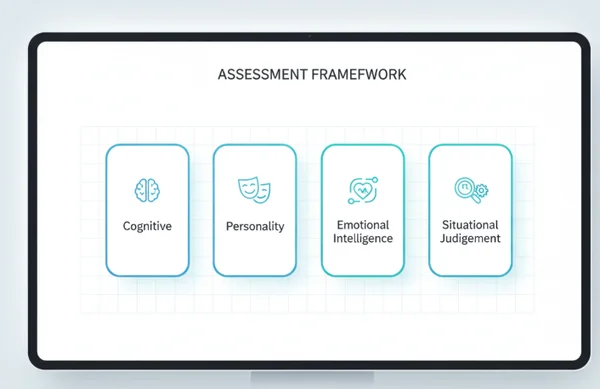
To fully grasp the psychometric test meaning, you must understand the different categories. Assessments generally fall into four distinct areas.
1. Cognitive and Aptitude Tests
A cognitive ability test measures your raw intellectual potential. It evaluates how quickly you process information, solve problems, and identify logical patterns. These tests often include numerical, verbal, and abstract reasoning sections. Employers use them to see if you can handle complex job demands.
2. Personality and Temperament Tests
A psychometric personality test explores your character. Instead of measuring what you can do, it measures how you prefer to do it. Are you introverted or extroverted? Do you thrive in structured environments or chaotic ones? This is highly valuable for self-discovery and relationship building.
3. Emotional Intelligence (EQ) Tests
Emotional intelligence tests evaluate your ability to understand and manage emotions. They measure empathy, self-regulation, and interpersonal skills. High EQ is strongly linked to leadership success and effective teamwork.
4. Situational Judgement Tests (SJTs)
SJTs present you with hypothetical work scenarios. You must choose the most appropriate response from a multiple-choice list. These tests assess your real-time decision-making and your intuition in professional conflicts.
Why Do Employers Use Psychometric Tests for Recruitment?
It is incredibly common to face a psychometric test for recruitment. But why do companies rely on them so heavily?
Unbiased Candidate Screening
Human bias is a major problem in traditional job interviews. Psychometrics provide a level playing field. Because they are standardized, they allow recruiters to evaluate candidates purely on their cognitive patterns and behavioral tendencies, ignoring background or appearance.
Predicting Job Performance and Cultural Fit
Resumes tell employers what you have done. Psychometric testing tells them what you will do in the future. A personality test for employment can reveal whether you naturally align with the company's culture. For instance, a highly cautious person might struggle in a fast-paced, high-risk startup environment.
5 Common Examples of Psychometric Test Questions
Are you nervous about what questions are asked in a psychometric test? Knowing what to expect is the best way to prepare. Let us look at five typical examples.
Example 1: Numerical Reasoning
You will be given a table of financial data or a graph. Question: "Based on the chart above, what is the projected revenue growth for Q3?" Goal: This tests your ability to interpret data rather than your advanced math skills.
Example 2: Verbal Reasoning
You will read a dense paragraph of text. Question: "Is the following statement True, False, or Cannot Say based on the text?" Goal: This measures your ability to digest complex information quickly and logically.
Example 3: Behavioral Scenarios
You are presented with a workplace conflict. Question: "A team member misses a critical deadline. What is your first action?" Goal: This assesses your situational judgement and leadership style.
Example 4: Personality Likert Scales
You will read a statement about a personal trait. Question: "I prefer working in loud, busy environments. Rate from 1 (Strongly Disagree) to 5 (Strongly Agree)." Goal: These consistency-checked questions build your psychological profile.
Example 5: Spatial Awareness
You will see 2D shapes that must be folded into 3D objects. Question: "Which 3D shape can be made from the 2D net shown?" Goal: This measures visual-spatial reasoning, crucial for engineering and architectural roles.
How Can Psychometric Tests Help With Personal Development?
While many people take these tests for a job interview, their true power lies in personal growth. You do not need an employer to tell you who you are.
Beyond the Workplace: The Value of Self-Awareness
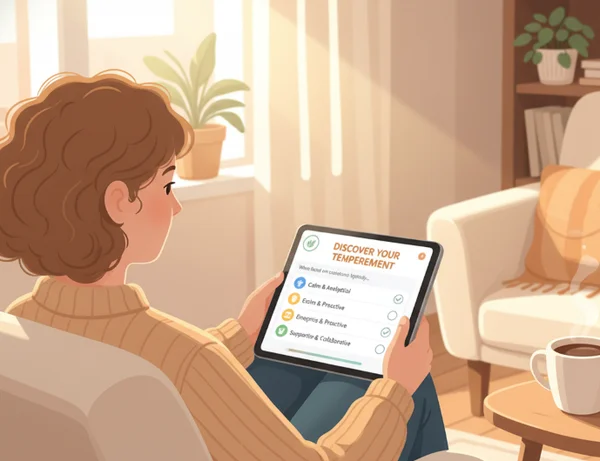
Understanding your own emotional patterns can change your life. A character test helps you pinpoint your strengths and identify potential blind spots. When you know your natural tendencies, you can communicate more effectively, manage your stress triggers, and choose environments where you will naturally thrive.
How to Reflect on Your Psychometric Test Results
Do not treat your results as a permanent label. Instead, view them as an educational roadmap. Ask yourself:
- Do these results align with my daily habits?
- How can I leverage these strengths in my current relationship?
- What micro-habits can I build to support my weaker areas?
Introducing Our Free Temperament Test
Ready to turn theory into practice? Discovering your psychological baseline has never been easier. We offer a scientifically backed assessment designed simply for your personal growth. By exploring your unique traits, you can unlock a deeper understanding of your core temperament. Consider taking 5 minutes to check your traits with this comprehensive temperament test guide.
Quick Summary Before Your Test
A psychometric test is a powerful objective tool for measuring cognitive potential and personality traits. Whether you are facing an aptitude test for your dream job or taking a free psychometric test for self-discovery, understanding the format is half the battle. Remember that personality assessments have no wrong answers. The goal is authenticity. If you are intrigued by your own mind, the best next step is to gently explore our AI-powered temperament test to gain personalized, actionable insights into your behavior.
Frequently Asked Questions
Are psychometric tests the same as IQ tests?
No. An IQ test strictly measures a specific type of cognitive intelligence. Psychometric tests are a broader category that includes cognitive abilities, personality traits, and emotional intelligence assessments.
Can you fail a psychometric test?
You can fail a cognitive or aptitude test if you do not meet the employer's required benchmark score. However, you cannot fail a psychometric personality test, as it simply measures structural traits without right or wrong answers.
How accurate are psychometric personality tests?
When designed scientifically, they are highly reliable in identifying broad behavioral tendencies. However, they are meant for educational and self-reflection purposes, not as clinical diagnostic tools.
Is it possible to fake answers on a psychometric assessment?
While you can try to guess what an employer wants, modern tests use consistency metrics to detect faking. Often, giving inauthentic answers distorts your profile and results in test invalidation.