Workplace Communication: Using Temperament Tests to Improve Team Dynamics
Workplace communication breakdowns cost businesses millions in lost productivity and team harmony. Misunderstandings, project delays, and team friction often stem from one simple source: different temperament types clashing without understanding each other. Have you ever felt like you and a colleague are speaking completely different languages?
This guide provides practical, temperament-based communication strategies to bridge those personality gaps. You will learn to identify different work styles and use ready-to-use scripts to create more effective and harmonious workplace interactions. The first step to mastering this is understanding your own style. You can discover your core tendencies with our free temperament test.

Understanding Temperament Types in Professional Settings
Before you can improve communication, you need a basic framework. Temperament theory dates back to ancient Greece. It provides us with a simple yet powerful way to understand innate behavioral tendencies. In a professional setting, recognizing these patterns helps you predict how colleagues might react, what motivates them, and how they prefer to communicate.
The Four Temperaments: Quick Reference for Busy Professionals
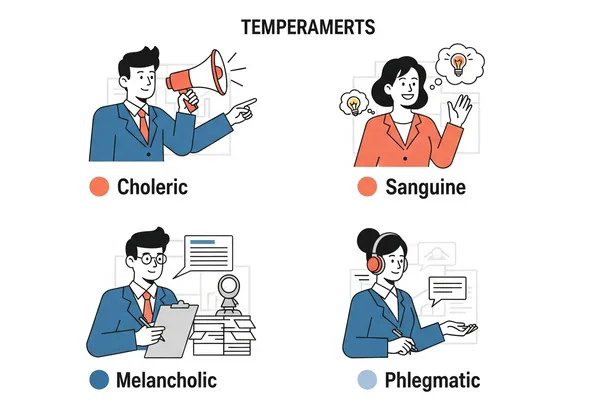
For busy professionals, think of the four temperaments as a quick guide to your team's operating systems. Each has distinct strengths and potential challenges.
-
The Choleric (Ambitious & Direct): These are your goal-oriented leaders. They are decisive, confident, and focused on results. They thrive on challenges and take charge.
-
The Sanguine (Enthusiastic & Social): These are the team’s social connectors. They are creative, optimistic, and great at brainstorming and motivating others. They thrive on collaboration and new experiences.
-
The Melancholic (Detail-Oriented & Analytical): These are your quality control experts. They are thoughtful, precise, and highly organized. They value accuracy and careful planning.
-
The Phlegmatic (Calm & Steady): These are the team’s peacekeepers. They are reliable, easygoing, and supportive. They bring stability and are excellent at mediating conflicts.
How Temperament Manifests in Work Communication Styles
Each temperament has a default communication style. Understanding these differences is the key to preventing misunderstandings.
- Choleric: Communication is direct, brief, and to the point. They want the bottom line first and get impatient with too much small talk or unnecessary detail. They value action over discussion.
- Sanguine: Communication is expressive, friendly, and energetic. They enjoy brainstorming out loud and may jump between topics. They value connection and positive reinforcement.
- Melancholic: Communication is precise, formal, and data-driven. They prefer written communication, like email, where they can lay out all the facts and details logically. They value thoroughness and clarity.
- Phlegmatic: Communication is diplomatic, calm, and questioning. They are great listeners but may not volunteer their opinions unless asked directly. They value harmony and consensus.
Practical Communication Scripts for Challenging Workplace Scenarios
Knowing the theory is one thing; applying it is another. Certain temperament pairings naturally create more friction. Here are practical scripts to navigate common challenging dynamics. The key is to slightly adapt your style to meet the other person where they are.

Managing Choleric-Melancholic Communication Friction
This is a classic clash between "get it done now" and "get it done right." The Choleric wants speed, while the Melancholic wants perfection. This can lead to frustration on both sides.
Scenario: A Choleric manager asks a Melancholic team member for a quick project update.
- What a Choleric might say: "Where are we on Project X? I need the status now."
- How a Melancholic might hear it: "You're too slow. Why isn't it done? You're not trusted to manage your time."
- Better Approach for the Choleric: "Hi [Name], I'm planning our next steps for Project X. Could you give me a quick summary of your progress and an estimated completion date by end of day?"
- Why it works: It provides context ("planning our next steps"), respects their process ("summary"), and gives a clear, reasonable deadline.
- Better Approach for the Melancholic: "I've completed the initial analysis and am now cross-referencing the data to ensure accuracy. I project it will be fully complete by Friday, but I can send you the preliminary findings this afternoon."
- Why it works: It shows progress, justifies the timeline with a focus on quality, and offers an interim solution to satisfy the Choleric's need for action.
Navigating Sanguine-Phlegmatic Collaboration Dynamics
Here, the challenge is energy and initiative. The Sanguine is full of ideas and ready to start, while the Phlegmatic is more reserved and prefers a clear, low-risk plan.
Scenario: A Sanguine and a Phlegmatic are brainstorming a new marketing campaign.
- What a Sanguine might say: "Let's do a viral video! And a flash mob! And let's launch it next week! It'll be amazing!"
- How a Phlegmatic might feel: Overwhelmed, skeptical, and pressured. They see the risks, not the excitement.
- Better Approach for the Sanguine: "I have a few exciting ideas for the campaign, including a potential video. What are your initial thoughts on the main goals we need to achieve? Your practical perspective would be really helpful in narrowing this down."
- Why it works: It validates the Phlegmatic's thoughtful nature ("practical perspective") and asks a specific, non-threatening question to start the conversation.
- Better Approach for the Phlegmatic: "Those are interesting ideas. To make sure we succeed, could we first outline the key steps, budget, and potential risks for one of them? Let's start with the video concept."
- Why it works: It doesn't dismiss the Sanguine's enthusiasm but gently guides them toward a structured process, which is the Phlegmatic's comfort zone.
Email Templates for Every Temperament Combination
Email is a common source of miscommunication. Use these templates as a starting point. Customizing your message for the recipient's temperament can dramatically improve the response you get.
To a Choleric (Be brief and action-oriented):
Subject: Decision Needed: Project X Proposal
Hi [Name],
Attached is the proposal for Project X.
Key decision needed: Please approve the budget on page 3 so we can move forward.
Let me know if you have any questions.
Thanks, [Your Name]
To a Melancholic (Be detailed and logical):
Subject: Detailed Proposal for Project X for Your Review
Hi [Name],
As discussed, please find the attached proposal for Project X. I’ve broken it down into three main sections:
- Project Goals and Rationale (Page 1)
- Detailed Timeline and Deliverables (Page 2)
- Budget Breakdown and ROI Analysis (Page 3)
Please review it at your convenience and let me know if you find any discrepancies or have questions about the data.
Best regards, [Your Name]
Implementing Temperament Awareness in Team Meetings
Meetings are where temperament dynamics are on full display. A poorly run meeting can favor one type (usually the most outspoken) while silencing others. A well-run meeting makes space for everyone to contribute their best.

Meeting Structures That Accommodate All Temperament Types
- Send an Agenda in Advance: This is crucial for Melancholic and Phlegmatic types. It gives them time to process information, gather their thoughts, and prepare to contribute meaningfully.
- Use a "Round Robin" Technique: Instead of a free-for-all, go around the table and ask each person for their input. This ensures Phlegmatics get a specific opportunity to speak and prevents Cholerics or Sanguines from dominating the conversation.
- Separate Brainstorming from Decision-Making: Dedicate the first part of a meeting to open brainstorming (Sanguine-friendly) without judgment. Schedule a separate time or the second half of the meeting for critical analysis and decision-making (Choleric and Melancholic-friendly).
Facilitation Techniques for Diverse Temperament Groups
As a meeting leader, your role is to be a facilitator who balances these energies.
- To engage a Phlegmatic: "John, you have a lot of experience in this area. What potential challenges do you see with this approach?" (Asks for their opinion directly and respectfully).
- To ground a Sanguine: "That's a fantastic creative idea. Let's park that on our 'idea board' and circle back to it once we've finalized the core plan." (Validates their creativity without derailing the meeting).
- To get clarity from a Melancholic: "Sarah, thank you for that detailed analysis. Could you summarize the top three risks for the rest of the team?" (Asks them to distill their detailed work into a concise summary).
- To build consensus with a Choleric: "Mark, I know you're eager to move forward. To ensure everyone is on board, let's do a quick final check for any major objections." (Acknowledges their drive while ensuring team buy-in).
Discovering your own temperament is the foundation for improving these interactions. A deeper self-awareness helps you see why you react the way you do. Find out your type by taking our online temperament test.
Start Applying Temperament Communication Strategies Today
The workplace communication landscape transforms when you understand the temperament dynamics at play. It’s not about putting people in boxes; it's about having a map to navigate different communication styles more effectively.
These practical strategies can transform team friction into productive collaboration. They also reduce misunderstandings and create a more inclusive, effective work environment. Don't try to do everything at once. Start with one technique this week—perhaps sending an agenda before your next meeting or rephrasing an email to a colleague—and notice the difference.
Ready to discover how YOUR temperament influences your workplace interactions? Take our test today to gain personalized insights that will help you leverage your natural strengths and better navigate challenges. Transform your workplace relationships—one conversation at a time. Start your test today and unlock a new level of workplace harmony.
Frequently Asked Questions About Workplace Temperament Communication
How do I know my temperament type at work?
The best way to get a reliable understanding is to take a scientifically-based test. Observing your own natural tendencies is also helpful. Do you prefer to lead, socialize, analyze, or support? A formal assessment, however, provides a more structured and objective view. You can try our free tool for a quick and insightful analysis.
Can temperament tests help improve team performance?
Absolutely. When team members understand their own temperament and the temperaments of their colleagues, it builds empathy and reduces conflict. This knowledge helps teams assign roles based on natural strengths, improve communication, and collaborate more effectively, leading to higher overall performance and morale.
What are the four categories of workplace temperament?
In the workplace, the four temperaments are often seen as different functional roles:
- Choleric: The "Driver" or "Leader" who focuses on results.
- Sanguine: The "Influencer" or "Motivator" who focuses on people and ideas.
- Melancholic: The "Analyst" or "Planner" who focuses on quality and process.
- Phlegmatic: The "Supporter" or "Mediator" who focuses on harmony and stability.
How is temperament different from personality in workplace settings?
Temperament is considered the innate, biological foundation of your personality—your natural "wiring." It describes your core energy, mood, and reaction intensity. Personality is much broader; it's the whole package, shaped by your temperament, upbringing, experiences, and culture. A temperament test helps you understand the "why" behind many of your automatic workplace behaviors.